Comparison of Different Attention Q Modes
A comprehensive analysis and comparison of different Attention Q modes including SDPA, Flash Attention variants, and sparsified attention mechanisms.
This document analyzes and compares different Attention Q modes (sdpa, flash_attn_2, flash_attn_3, sageattn, spargeattn, spargeattn_tune).
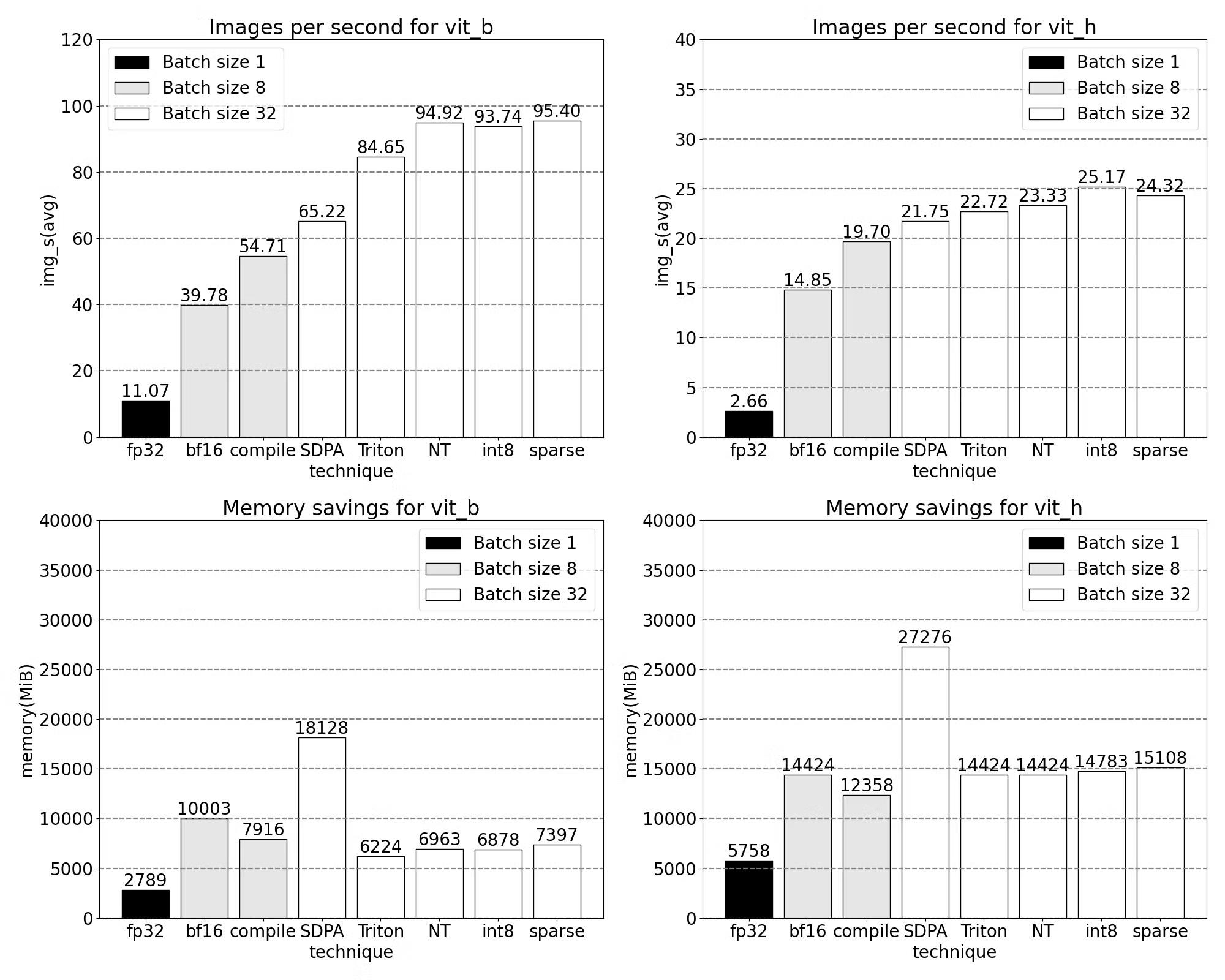
Quick Glimpse: Throughput vs. Memory Efficiency
To highlight the improvements, we benchmarked our newly released PyTorch-native features on an AWS p4d.24xlarge instance (8× A100 GPUs).
The results demonstrate increased throughput and reduced memory overhead.
1. SDPA (Scaled Dot Product Attention)
- SDPA is the classical attention mechanism in Transformers, which computes attention weights by scaling dot products. It is the foundation for many modern Transformer models, such as GPT-3 and BERT.
- PyTorch's SDPA implementation is highly optimized and supports multiple backends (CPU, GPU, CUDA, AMD, etc.), and it can also be accessed via the BetterTransformer API for acceleration.
- SDPA is easy to implement but may suffer from efficiency and memory bottlenecks as sequence length grows.
2. Flash Attention 2 (Flash Attention-2)
- Flash Attention 2 is a modified attention mechanism that optimizes computation order through tiling and recomputation to improve throughput.
- Flash Attention 2 has been integrated into PyTorch and can be directly called via
torch.nn.functional.scaled_dot_product_attention. - In some cases, Flash Attention 2 is faster than SDPA, especially when processing long sequences. However, it may require specific hardware support (such as H100 or A100 GPUs).
3. Flash Attention 3 (Flash Attention-3)
- Flash Attention 3 is a further optimized version of Flash Attention 2, running twice as fast.
- It is still in the experimental stage, currently only supports head dimensions of 128, and has not yet been widely adopted in production environments.
4. Sage Attention (SageAttn)
- Sage Attention is a sparsified attention mechanism that reduces VRAM usage via block-sparse and low-rank approximation techniques while maintaining accuracy.
- It is suitable for scenarios where memory efficiency is crucial, especially on resource-constrained devices.
5. Sparge Attention (SpargeAttn)
- Sparge Attention is another sparsified attention mechanism that reduces unnecessary computation and memory usage.
- It is designed for scenarios requiring lower memory overhead, effectively reducing memory consumption.
6. Sparge Attention Tune (SpargeAttn_Tune)
- Sparge Attention Tune is an optimized version of Sparge Attention, further improving efficiency by adjusting sparsification parameters.
- It provides more flexible optimization to achieve better performance.
Summary
- SDPA is the classical choice, suitable for most scenarios, but may be inefficient when handling very long sequences.
- Flash Attention 2 and Flash Attention 3 are high-efficiency mechanisms, suitable for long-sequence scenarios, especially for large-scale processing.
- Sage Attention and Sparge Attention are optimized for memory efficiency, ideal for resource-constrained devices.
- Sparge Attention Tune is a refined version of Sparge Attention, suitable for scenarios requiring further fine-tuning.
When selecting an attention mechanism, consider factors such as use case, hardware support, and memory requirements.